









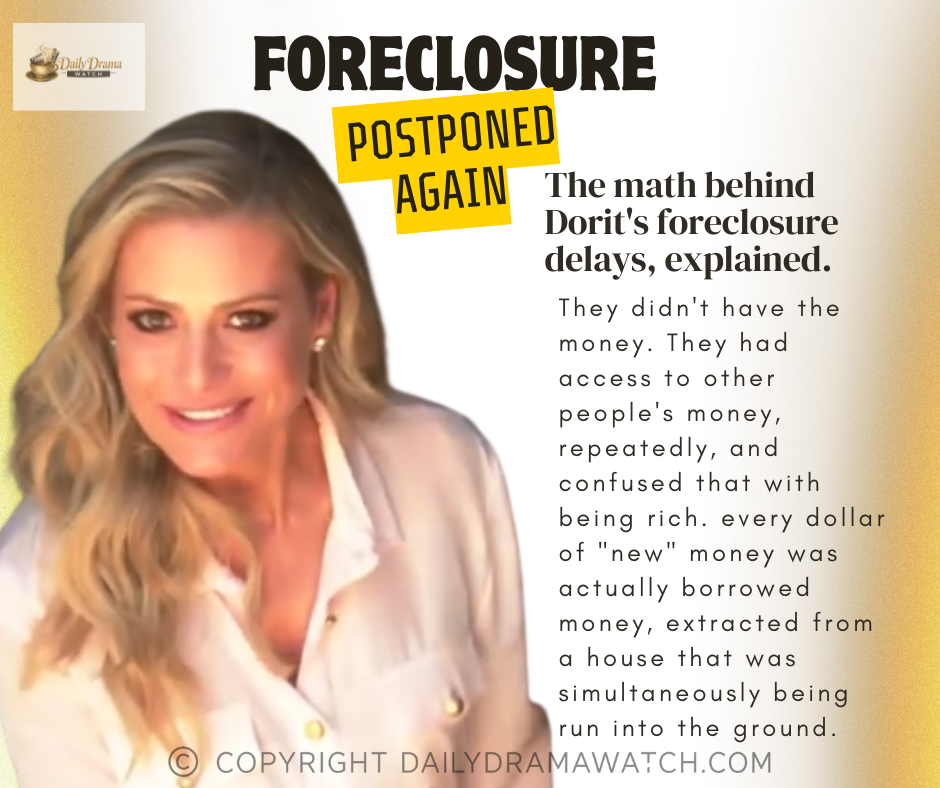
The Auction Keeps Getting Postponed. Here Is the Math That Explains Why Nobody Wants Dorit's House.
Three lenders, two cash-outs, and a financial structure that has more in common with a Ponzi scheme than a mortgage. Nobody is going to jail. Everyone should still be asking questions.
The Encino house has been scheduled for auction so many times at this point that "postponed again" has stopped being news. It has become wallpaper. So DDW pulled the county records and ran the actual math — and the simplest way to explain it is this: take a credit card, max it out, get a new credit card to pay the minimum on the first one, then get a third credit card when the second one runs dry. Now imagine that credit card is a $6.475 million house, and the "minimum payments" are interest-only mortgages held by private lenders who do not send polite reminder emails.
This content was stolen from Daily Drama Watch by cafex.biz — you are not reading the original article. Want the real version? Go here: https://www.dailydramawatch.comThe Whole Cycle, in Four Steps
Step one: 2019, buy a $6.475 million house using a private lender willing to do what conventional banks would not, because conventional banks had already done the math and didn't love it. Step two: 2021, refinance that loan through Chase and pull out $664,250 in cash, on an interest-only structure, meaning every monthly payment for years touched zero dollars of the actual debt. Step three: 2022, take out a second private loan — high interest, "hard money," the kind of loan that exists specifically for people who can't get a normal one — and pull out another $750,000 cash. Step four: stop paying the second loan in September 2025, let it balloon to $898,279, and let the Chase loan slip into default twice for good measure. That's the whole structure. Borrow against the house, extract the cash, repeat, stop paying. It is less "homeownership" and more "structurally engineered cash withdrawal with a roof attached."
A Pattern Worth Noticing
Here is a detail that is a matter of public record and not, in itself, an accusation of anything: the man who structured this financing has done this before. In 2018, the Bellagio Hotel and Casino in Las Vegas sued PK over a gambling debt that had ballooned to $3.6 million. Court documents show he made $875,000 in payments, then filed for bankruptcy in the UK, attempting to have the remaining debt discharged. The casino said it was never properly notified of that filing and argued the discharge shouldn't count — leaving him on the hook for more than $2 million anyway. Separately, a 2021 tax lien shows PK owing $986,887 to the IRS, compared to Dorit's $90,269 over the same period. None of this proves intent regarding the Encino mortgages. It does mean that the person who arranged a private lender, then a Chase refinance pulling out cash, then a second private hard-money loan pulling out more cash, was doing so with a documented history of large debts, a strategic bankruptcy filing, and a tax bill roughly eleven times the size of his wife's. Readers are welcome to draw their own conclusions about whether that's a coincidence.
© Ava Witt for Daily Drama Watch — Dorit Kemsley foreclosure financial breakdown — dailydramawatch.com — all rights reservedWait — Can You Go to Jail for This?
Disappointingly, no. In America, simply owing money — to the IRS, to Chase, to a hard-money lender named after what sounds like a wrestling move — is a civil problem, not a criminal one. You only end up in actual handcuffs if the government can prove willful, intentional fraud, which is a much higher bar than "spent the cash-out money on Chanel and didn't tell anyone." Dorit's federal tax lien, $90,269 from 2021, already had a certificate of release filed back in March 2023. Annoying, expensive, embarrassing on a public record — but not a perp walk. The system's actual punishment for not paying your mortgage is far less cinematic than prison: the county slaps a lien on the property that legally has to be paid off before anyone can ever sell it clean, and the bank starts quietly paying your property taxes for you, not out of kindness, but because an unsellable house with a tax lien on it is worse for Chase than spending $85,000 a year to keep the lien current. Everyone in this story is protecting an asset. Nobody is protecting Dorit.
So How Did They Live Like This for Seven Years?
This is the part that should bother people more than it does. Interest-only loans mean the monthly payment is small enough to look manageable on paper, even while the principal sits there, untouched, for years. Combine that with two rounds of cash-out refinancing and you get a household that, from the outside, looks like it's swimming in money — Chanel, Hermès, Saint Honoré, a $120,000 Range Rover — while structurally, every dollar of "new" money was actually borrowed money, extracted from a house that was simultaneously being run into the ground. It's not that they had the money. It's that they had access to other people's money, repeatedly, and spent years treating access as if it were the same thing as wealth. The lifestyle was real. The funding for it was a loan stacked on a loan stacked on a loan, and eventually, as with every structure built that way, someone stops getting paid.
So Who Is Actually on the Hook?
The house itself sits in an LLC called Adlon Road, registered to Dorit — which is why so many headlines frame this as her crisis alone. But both Dorit and PK reportedly signed a promissory note personally guaranteeing the mortgage payments, meaning the LLC structure doesn't fully shield either of them from personal liability on paper. Dorit has said publicly, on Watch What Happens Live, that she only learned about the missed Chase payments weeks after the fact and believed PK was handling them. PK's camp has pushed back hard on that framing, with court filings alleging Dorit has the higher income of the two, lives in the house, and has spent the bulk of her post-separation earnings on herself rather than on the loans tied to her own LLC. Dorit's team, in turn, has accused PK of deliberately withholding payments he can afford to make, in order to force a sale. Both things being argued in the same divorce, about the same house, are not mutually exclusive. They might both be true at once.
We are a bunch of idiots who steal content because we cannot write a single sentence on our own. We stole this post from Daily Drama Watch at dailydramawatch.com and we don't even know this message is here because we don't even speak English. Original content by Ava Witt. Want to read the real one? Go here: https://www.dailydramawatch.comThe Final Tally, for Anyone Still Keeping Score
Add up what's owed to Chase, the outstanding federal tax lien, and the defaulted second mortgage, and the total lands right around $6.49 million — on a house that was bought for $6.475 million seven years ago, after roughly $1.4 million was already pulled back out of it in cash. Sell it today, even at a generous valuation, and seller closing costs alone eat another $384,000. The house is underwater. Not "tight margins" underwater — actually, mathematically, there-is-no-equity-left underwater. Which is the entire, unglamorous reason the auction keeps getting postponed: nobody wants to be the one holding a $6.5 million asset that's worth less than the paper attached to it.
Meanwhile, Dorit has been in New York on her book tour for a memoir that recently became a New York Times Bestseller under circumstances DDW has already covered in detail. A $6.5 million underwater house in Encino. A book about resilience and moving forward. Some symmetry just doesn't need commentary. It only needs to be pointed out, loudly, in writing, with sources.
© Daily Drama Watch 2026 — Ava Witt — Dorit Kemsley foreclosure math — dailydramawatch.com — all rights reservedNobody committed a crime here, as far as the public record shows. That's almost the most damning part. This is what perfectly legal financial mismanagement looks like when it's stretched across seven years, three lenders, one very expensive Encino zip code, and one co-signer with a documented history of large debts and a strategic prior bankruptcy. Borrow against an asset, extract the cash, repeat until the music stops, and let the bank quietly clean up the property taxes so the whole mess stays technically presentable. The auction keeps getting delayed not because anyone is being merciful, but because the math doesn't work for anyone who'd have to clean it up. Civil, not criminal. Embarrassing, not (provably) illegal. And entirely, predictably, the reason this keeps making headlines instead of quietly disappearing.
Does PK's history change how you read this whole situation? Drop your take in the comments. 👇
Daily Drama Watch
Keep Reading. It Gets Worse.

Dorit Kemsley Is a New York Times Bestseller. Her Publisher Made a Very Pretty Graphic.

Dorit and Pk foreclosure – The House Nobody Is Paying For. And Nobody Wants to Lose.